Garage Inference set teams a deliberately awkward challenge: build something genuinely useful using only "garage-grade" language models — small enough to run on a laptop, often under a billion parameters, where raw capability is scarce and every other engineering decision has to compensate. Across 72 hours in early May, 37 teams shipped tools that, judged on model size alone, had no business working as well as they did. The scoring centered on a single idea — the "Wow Gap," the distance between what the underlying model could do alone and what the engineered system actually delivered.
✯ Grand Prize Winners
- 1st Place — Root Access Award — EDGEDOCTOR AI (Team: BharatEdge). An offline medical-triage system that wraps a 0.6B-parameter model in seven layers of deterministic engineering. Where the raw model, given "chest pain, left arm numb," answers "stay hydrated and rest," the engineered system produces safe triage. "The engineering principle here is stated and delivered: the deterministic safety layer classifies emergencies without touching the model."
- 2nd Place — Runner-Up — Atomic PR Surgeon (Team: RAG Tag). A zero-cost code reviewer running an ensemble of four specialized micro-agents on a 600M-parameter model — catching SQL injection, N+1 queries, and cross-file vulnerabilities, then generating fix patches, entirely locally. "An absolutely stellar project. You identified a highly specific, painful real-world problem and solved it in the most privacy-respecting way — the code never leaves the customer's environment."
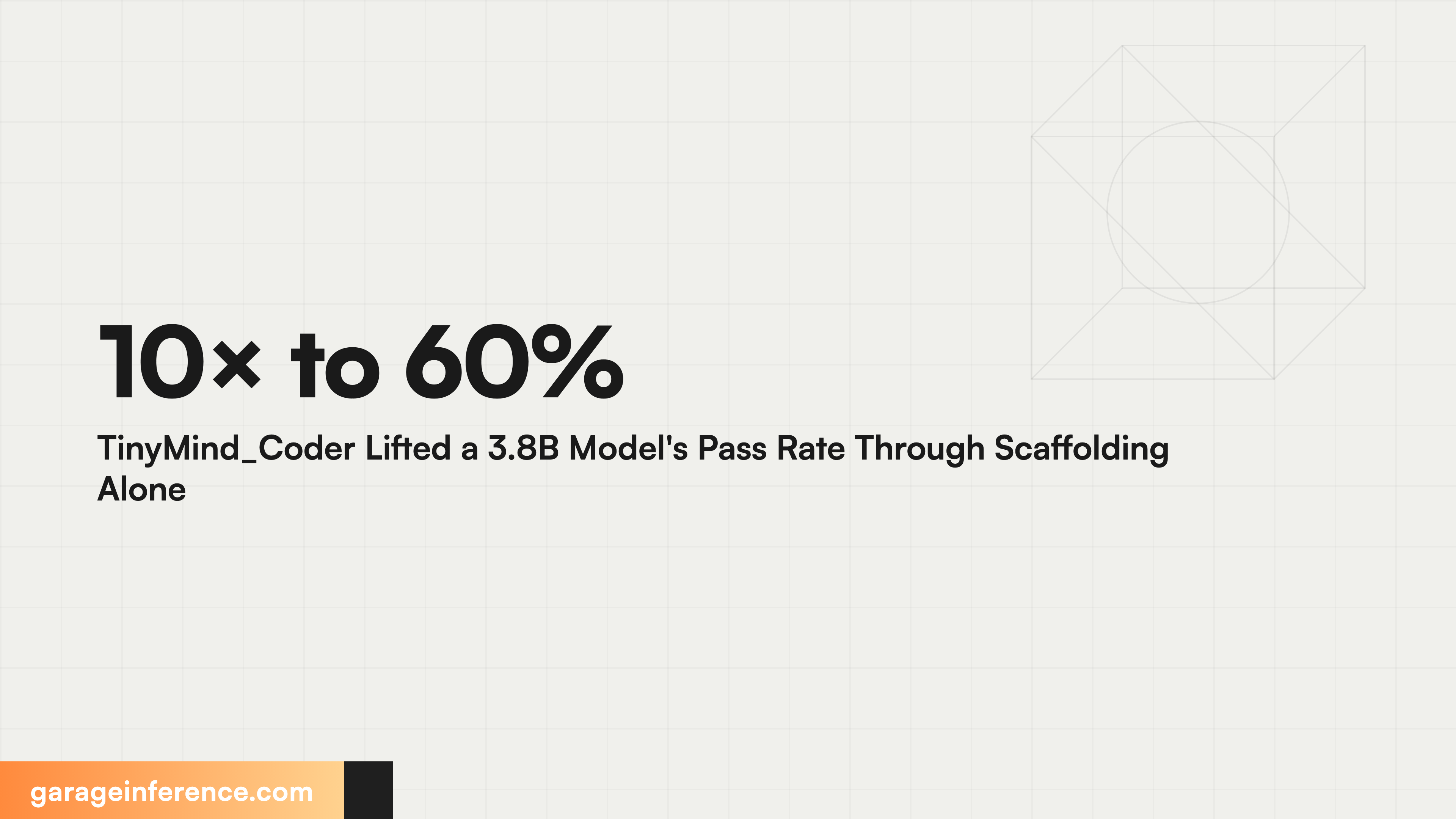
- 3rd Place — Finalist — TinyMind_Coder (Team: TinyMind Labs). Structured reasoning loops, execution feedback, and lightweight verification push a small model far past its baseline. "The clearest Wow Gap in this judging set: the same 3.8B model goes from ~10% to ~60% pass rate on hard coding problems purely through scaffolding."
✯ Spotlight — Best Wow Gap
- Marionette (Team: Marionette). A browser assistant running a full autonomous agent on Gemini Nano — a model small enough to ship inside Chrome — that lives on your machine and answers only to you. "Running a full autonomous browser agent on Gemini Nano is genuinely a feat of engineering. Use of a vault for credentials is a good touch."
✯ Community Choice
- Tiny Review (Garage AI). Voted by the community: a code reviewer running Gemma 2B quantized entirely inside a browser tab via WebLLM and WebGPU — no server, no install, no data leaving the device. "Running quantized inference entirely inside a browser tab, with nothing leaving the device, is exactly the kind of constraint-native engineering this event was built to reward."
✯ Excellence Tier
- DecideAI (Berlin) — A constraint-aware decision engine that turns messy questions into data-backed decisions, deliberately removing the model from the ranking logic and handing scoring to a deterministic pipeline. "Fantastic systems thinking — the removal of the LLM from any ranking and the use of deterministic scoring was particularly appealing."
- OSS Pulse (Ravager) — A continuously running engine that ranks open-source repositories by real momentum rather than star count. "A very practical approach with lots of possibilities for the development community — ranking repositories by momentum rather than stars is genuinely novel."
- AI CAD Generation (Thriller) — Natural-language descriptions turned into functional 3D parametric CAD models in real time, entirely in the browser. "The translation of natural language to parametric CAD models in the browser showcases good engineering thinking and real-world application."
- smartname (keystone) — A local-first utility that renames files by their actual content, powered by Qwen 3 0.6B. "Using Qwen 0.6B to achieve content-based renaming on a local machine is remarkable — local-first, low-resource, and genuinely user-friendly."
- Prescription_reader (Error909) — Converts handwritten prescriptions into structured digital records using OCR, small-model extraction, and drug validation. "A highly practical project with direct applications in healthcare — OCR, structured extraction, and pharmaceutical validation in one process flow."
- HALS (DINooo) — Turns documents into adaptive quizzes and intelligent learning experiences with lightweight models. "Great application in education with tangible benefits — converting documents to adaptive tests via lightweight models is genuinely useful."
✯ Top-Tier Evaluation Panel
Projects were scored across six criteria — Wow Gap, Practical Usefulness, Technical Execution, Creativity & Innovation, Accessibility & Reproducibility, and Secure Design — by a 37-judge panel. Headlining that panel were senior engineers across consumer hardware, cloud infrastructure, and applied AI:
- Manushi Sheth — Data & AI Leader, Product Data, Sonos. Evaluated projects through the lens of data discipline, rewarding teams that built explicit verification boundaries between the model and anything that trusted its output.
- Sumanth Kadulla — Cloud Infrastructure & DevOps Engineer (AWS, Azure, GCP). Assessed deployability — cost per request, cold-start behavior, failure isolation, and secure handling of inputs.
- Deniz Aleyna Akbasaran — Product & Data, AI Agent Evaluation, Gorgias. Focused on whether teams could prove their tools worked repeatably on inputs they did not choose.
- Nishant Sinha — Engineering Lead, Amazon. Brought nine years of building distributed and edge-ML systems, evaluating projects against the realities of running inference outside the data center.
The pattern beneath the results was consistent: the projects that won treated the model as one untrusted component inside a larger, mostly deterministic system. Verification layers, caching, lineage, and local-first deployment recurred far more often among the strongest entries than any particular modeling trick — proof that, at the garage scale, the constraint really is the creativity.